By BRIAN MELLEY Associated Press
LONDON (AP) — Fears of artificial intelligence inspired the Cambridge Dictionary to flip back to the 15th century for the word that best captures the 2026 cultural zeitgeist.
“Human,” the dictionary’s word of the year, is not just a throwback but also a backlash of sorts that reflects the debate over how AI has blurred the lines between machines and people.
“AI is changing how we talk about being human,” said Colin McIntosh, the dictionary’s lexicographer. “Fears about what humans may lose when we outsource our thinking have made us reconsider the extent to which we rely on AI: from top mathematicians to teachers of young children.”
The adjective derived from the Latin “humanus” and in use since the 1450s is defined by Cambridge as “having the qualities, faults and feelings that people have, as opposed to gods, animals or machines.”
Dictionaries typically choose a novel word — sometimes slang that has crossed into the mainstream — or an existing word that has taken on a new meaning.
Artificial intelligence has factored heavily in Word of the Year distinctions across several dictionaries in recent years.
“AI” itself was chosen by Collins Dictionary in 2023 — a year when Cambridge picked “hallucinate,” in reference to the tendency of AI to fabricate information. Merriam-Webster last year named “slop” its word of the year for low quality content produced by AI while Collins went with “vibe coding” for the AI-assisted software development method.
“AI is making us think harder about what it means to be human,” Microsoft co-founder Bill Gates, who has promoted the smart use of AI, said in a comment on the Cambridge Dictionary selection. “The measure of AI’s success should be how much it improves human lives.”
Other word contenders for 2026 included “agent,” for an AI system that can make decisions and operate without human control and “analogue” for experiences or objects not involving the internet or digital technology.
___
Editors note: This story was produced by a human.
News
Cambridge Dictionary chooses ‘human’ as word of the year in response to AI fears
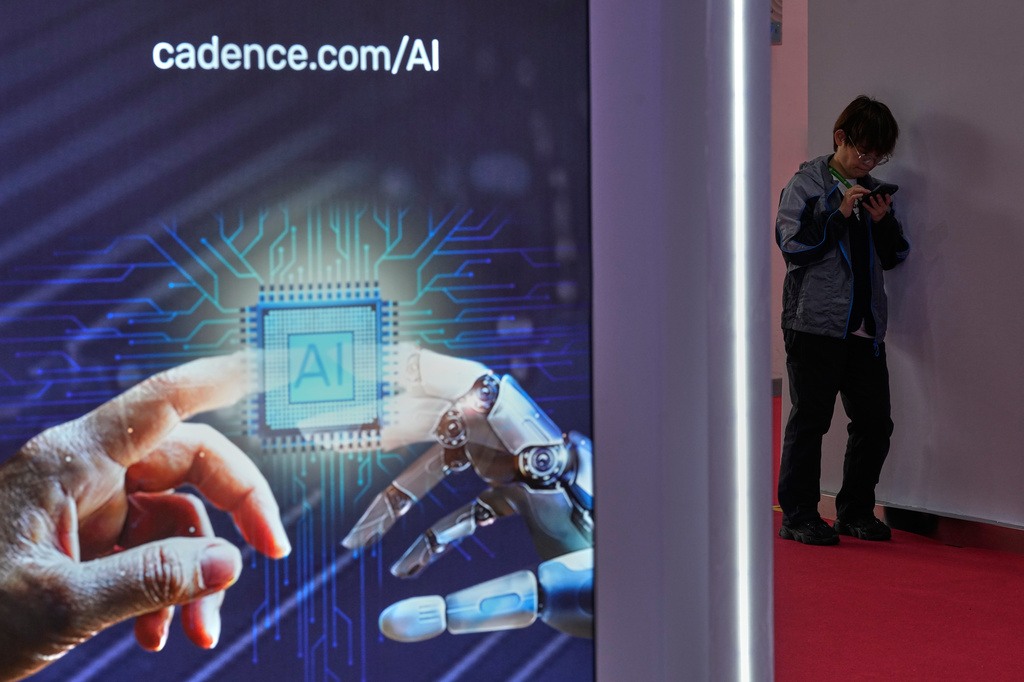
FILE -A man browses his phone near an artificial Intelligence (AI) booth at the China International Supply Chain Expo in Beijing on June 25, 2026. (AP Photo/Andy Wong, File) Photo: Associated Press